Solicitor vs. Attorney: A British Expat’s Guide to Hiring Family Counsel in the US
Confused by US legal terms? Learn the difference between a solicitor and an attorney in this guide for British expats navigating family law, divorce jurisdiction, and cross-border assets.
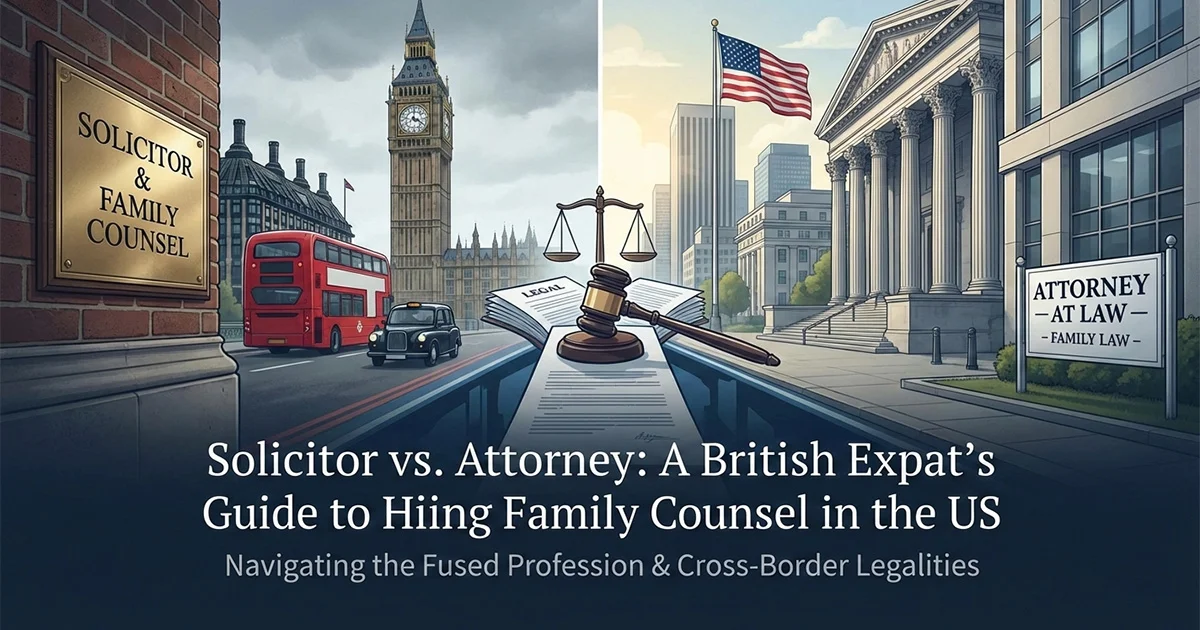
Introduction For British expatriates living in the United States, navigating a family crisis—whether it’s a divorce, a custody dispute, or the drafting of a prenuptial agreement—is doubly stressful. Not only are you dealing with the emotional fallout of a relationship breakdown, but you are also confronting a legal system that speaks a different language. You might find yourself searching Google for a "family law solicitor," only to be bombarded with results for "attorneys," "litigators," and "counselors."
It is a common source of anxiety: Is an attorney the same as a solicitor? Do I need a barrister for court? Will my English legal concepts apply here?
This guide aims to demystify the terminology and structure of the US legal profession for UK expats, helping you find the right representation to protect your family and your assets across borders.
The "Fused" Profession: Where are the Solicitors?
In the United Kingdom, as well as Australia, Hong Kong, and other Commonwealth jurisdictions, the legal profession is traditionally "bifurcated" (split in two).
-
Solicitors: These are your primary advisors. They work in offices, handle your paperwork, negotiate settlements, and manage the day-to-day progress of your case.
-
Barristers: These are specialist advocates. They are self-employed, work in "chambers," and are typically hired by the solicitor to argue complex matters in court.
In the United States, the profession is fused. There is no distinction between a solicitor and a barrister. A US Attorney-at-Law (or "lawyer") is licensed to do it all. Your US family law attorney will:
-
Meet with you and advise you (Solicitor work).
-
Draft your divorce petition and financial disclosures (Solicitor work).
-
Stand up in court and cross-examine witnesses before a judge (Barrister work).
For an expat, this can actually be an advantage. You do not need to pay for two separate legal professionals. The attorney you build a relationship with in the office is the same person who will fight for you in the courtroom.
A Crucial Exception: The South Carolina "Solicitor"
If you are living in or have legal issues in South Carolina, you must be careful with your terminology. South Carolina is unique in the US because it uses the title "Solicitor" to refer to the elected state prosecutor—the equivalent of a District Attorney (DA) in other states.
If you search for "family solicitor" in Charleston or Columbia, you may find yourself contacting the office that prosecutes domestic violence crimes, rather than a private lawyer who can help you with a divorce. Always look for "Family Law Attorney" or "Divorce Lawyer" to ensure you are finding private civil representation.
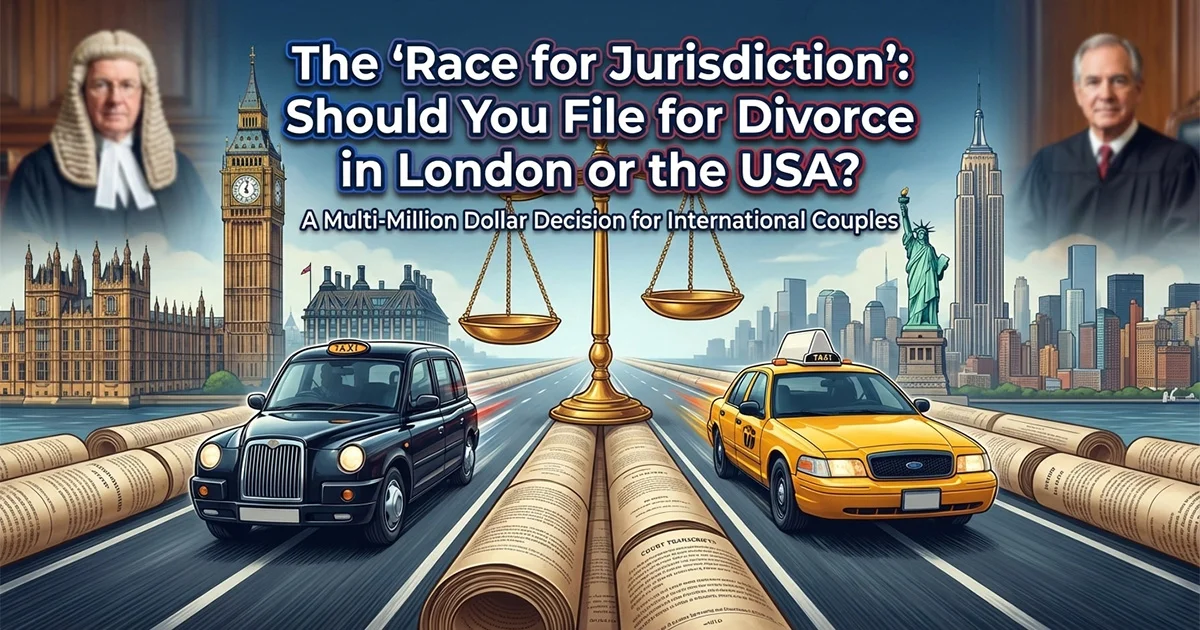
The "Race for Jurisdiction": Why Speed Matters
One of the most dangerous misconceptions for expats is assuming that divorce laws are roughly the same in the US and UK. They are not. In fact, the financial outcome of your divorce can vary by millions of dollars (or pounds) depending on where the divorce is filed.
-
The English Approach: English courts are often viewed as more generous to the financially weaker spouse (often the wife). They tend to view marriage as a partnership of equals and often start with a 50/50 split of all assets, including those brought into the marriage. They also have a reputation for awarding lifetime spousal maintenance in certain cases.
-
The US Approach: US laws vary by state. Many states follow "equitable distribution," which separates "marital property" from "separate property" (assets owned before marriage). US courts are generally stricter about limiting the duration of alimony (spousal support).
This creates a "Race for Jurisdiction." If you are the higher earner, you might prefer a US divorce. If you are the dependent spouse, you might prefer an English divorce. Because international treaties often prioritize the court where the case is filed first, hesitation can be costly.
Dual-Jurisdiction Awareness: What to Ask Your Attorney
When interviewing US family law attorneys, you need someone who isn't just a local expert, but who has "dual-jurisdiction awareness." Here are three questions to ask:
-
"Do you understand the concept of Domicile vs. Residence?" In the UK, "domicile" is a sticky concept attached to your heritage, while in the US, "residency" is often just about where you live now. You may be able to divorce in England based on your domicile even if you live in New York. Your attorney needs to know this to advise you on the best strategic move.
-
"How do you handle foreign assets and pensions?" Splitting a US 401(k) is standard for a US lawyer, but do they know how to handle a UK NHS pension or a SIPP? You need an attorney who can collaborate with UK experts to ensure tax-efficient division of cross-border assets.
-
"Are you familiar with the Hague Convention?" If you are thinking of moving back to the UK with your children, you cannot simply get on a plane. That could be considered international child abduction under the Hague Convention. You need an attorney who can legally petition the court for "relocation" or "leave to remove".
Conclusion
While the sign on the door says "Attorney" instead of "Solicitor," the service you need is the same: expert, compassionate, and robust legal protection. By understanding the fused nature of the US legal profession and the high stakes of international jurisdiction, you can choose a legal team that bridges the gap between your home and your new life abroad.
Related Articles


Featured Lawyers



Recommended Articles