
The 2026 Strategic Guide to Federal Trademark Protection: Regulatory Frameworks, Procedural Mechanics, and Asset Management for Startups
Navigate the 2026 USPTO regulatory overhaul. A strategic guide to new trademark fees, ID.me verification, and asset protection for startups in the post-TEAS era.
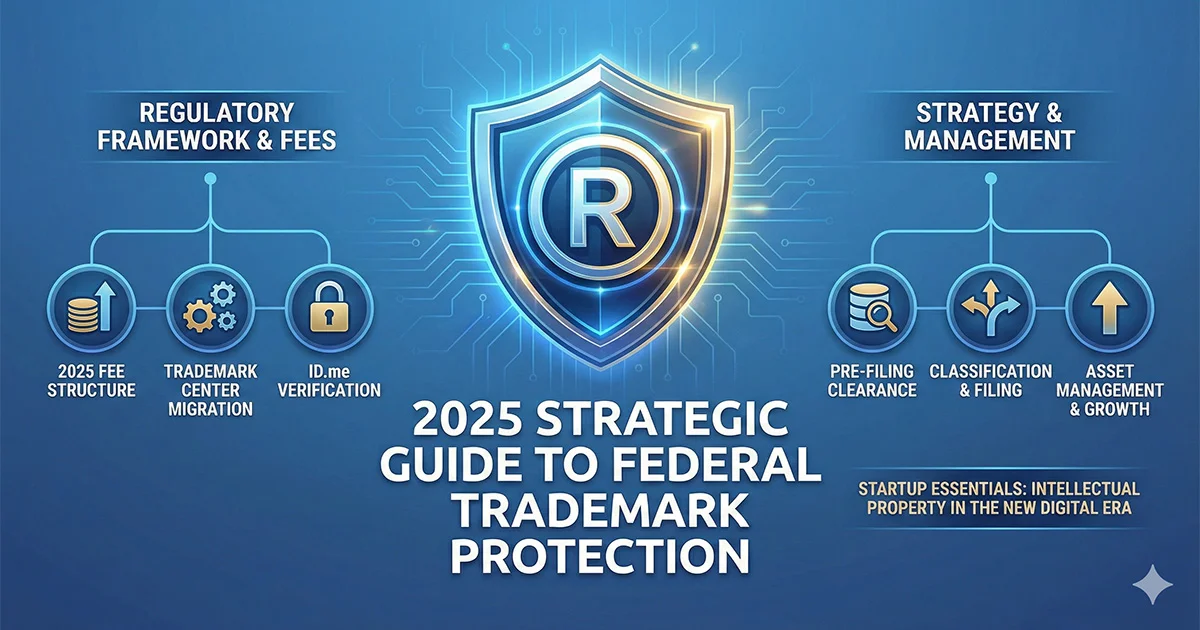
The USPTO's regulatory framework underwent a seismic shift effective January 18, 2026. This section analyzes the transition from the legacy TEAS system to the Trademark Center and the economic implications of the new fee schedule.
1. Retirement of TEAS and Launch of Trademark Center
For decades, the Trademark Electronic Application System (TEAS) was the standard interface for filing. It offered two tiers: TEAS Plus (cheaper, stricter) and TEAS Standard. As of January 2026, TEAS has been retired for initial applications.
The new Trademark Center is now the mandatory platform for all filings. It represents a modernization of the IT infrastructure, offering centralized docketing, draft sharing features for legal teams, and a more intuitive user interface.15 However, the migration has operational consequences:
-
Data Loss: Drafts created in TEAS that were not submitted by the cutoff date were deleted.
-
Unified Workflow: The Trademark Center integrates the application, response, and post-registration maintenance workflows into a single dashboard, theoretically reducing administrative friction.17
2. The 2026 Fee Restructuring
The 2026 Final Rule eliminated the "TEAS Plus" ($250) and "TEAS Standard" ($350) distinction. In its place is a single Base Application Fee of $350 per class. While this simplifies the headline rate, the USPTO introduced a system of surcharges designed to penalize applications that increase the examination burden.
Table 1: Comprehensive 2026 Trademark Fee Schedule Analysis
|
Filing Type / Fee Category |
Pre-2026 Fee |
2026 Fee (Effective Jan 18) |
Strategic Implication |
|
Base Application (Electronic) |
$250 (TEAS Plus) / $350 (Standard) |
$350 per class |
Eliminates the low-cost entry point for budget-conscious startups. |
|
Paper Application Surcharge |
$750 |
$850 + Base Fee |
Effectively prohibits paper filing for all but the most tech-averse. |
|
Custom ID Surcharge |
$0 |
$200 per class |
Critical: Penalizes using free-form text instead of the ID Manual. |
|
Insufficient Info Surcharge |
$0 |
$100 per class |
Penalizes incomplete data (e.g., missing translations). |
|
Statement of Use (SOU) |
$100 |
$150 per class |
Increases the cost of "Intent-to-Use" applications. |
|
Petition to Revive |
$150 |
$250 |
Higher penalty for missing Office Action deadlines. |
|
Letter of Protest |
$50 |
$150 |
Triples the cost to flag infringing applications to the USPTO. |
|
Section 8 Declaration |
$225 |
$325 per class |
Increases the 5-year maintenance cost. |
|
Section 9 Renewal |
$300 |
$325 per class |
Increases the 10-year renewal cost. |
|
Madrid Protocol (Section 66a) |
$500 |
$600 per class |
Raises the barrier for international expansion via WIPO. |
3. The Custom Identification Trap
The most financially dangerous element of the new rules for startups is the Custom Identification Surcharge.
-
The Mechanism: The USPTO maintains a "Trademark ID Manual" containing thousands of pre-approved descriptions of goods and services. If an applicant selects these pre-approved descriptions, they pay only the $350 base fee.
-
The Surcharge: If an applicant chooses to write their own description (free-form text) because their product is novel or complex, the USPTO charges an extra $200 per class.
-
The Character Limit: Additionally, if the custom description exceeds 1,000 characters, there is another $200 surcharge for each additional 1,000 characters.
Scenario: A Web3 startup creating a "decentralized autonomous organization (DAO) governance token for fractionalized real estate" might find that no pre-approved ID covers this. If they write a custom description, their filing fee jumps from $350 to $550 per class. If the description is verbose, it could reach $750. This incentivizes startups to try and "shoehorn" their products into existing categories, which carries the risk of the description being inaccurate and the trademark being vulnerable to cancellation.
IV. Identity Verification: The Digital Gatekeeper
A major component of the USPTO's modernization is the mandatory identity verification for all filers, including unrepresented (pro se) applicants and attorneys. This measure, powered by ID.me, is designed to combat fraudulent filings and "trademark farms" that clog the registry.
1. The ID.me Verification Protocols
Accessing the Trademark Center requires a verified USPTO.gov account. Verification is a one-time process but is rigorous. There are two primary pathways:
A. Self-Service Biometric Verification
This is the fastest route, typically taking 15 minutes. It uses facial recognition technology.
-
Requirements: A smartphone with a camera, a government-issued photo ID (Driver's License, Passport, State ID), and a Social Security Number (SSN).
-
Process: The user uploads a photo of their ID and then takes a "video selfie." The system matches the biometric data from the selfie to the ID photo.
-
Privacy: The USPTO does not store the biometric data; ID.me acts as the trusted broker. The name on the account is automatically updated to match the ID exactly.
B. Video Chat Agent
For users who cannot or will not use facial recognition (or if the automated system fails), a live video interview is required.
-
Requirements: Two forms of identification (e.g., Passport + Driver’s License, or Driver’s License + Health Insurance Card).
-
Process: The user joins a queue for a video call with a "Trust Referee." The user must hold their documents up to the camera for inspection. Wait times can vary significantly depending on volume.
2. Role-Based Access and Sponsorship
The new system enforces strict role-based access.
-
Trademark Owners: Can file their own applications but must verify their own identity.
-
Attorneys: Must verify their identity and can then "sponsor" support staff (paralegals).
-
Support Staff: Paralegals must create their own accounts and verify their identities via ID.me. Once verified, the attorney "sponsors" them, granting them access to the attorney's docket to prepare drafts. Staff cannot sign applications; only the verified attorney or the applicant can sign.
Operational Note: Startups should ensure their legal representative (or the founder if self-filing) completes this verification well in advance of any filing deadline, as troubleshooting ID.me issues can take days.
V. Pre-Filing Intelligence: Clearance and Strategy
Before engaging with the Trademark Center, a startup must conduct rigorous due diligence. The high rate of trademark refusals (over 60% of applications receive an Office Action) is often due to inadequate pre-filing clearance.
1. The "Likelihood of Confusion" Analysis
The USPTO does not merely look for exact matches. The statutory standard for refusal under Section 2(d) of the Lanham Act is "Likelihood of Confusion." This exists when marks are so similar—and the goods/services so related—that consumers would mistakenly believe they come from the same source.
Examiners use the DuPont Factors (or Polaroid Factors in some courts) to assess confusion. The two most critical factors are:
A. Similarity of the Marks
Marks are compared based on sound, appearance, and commercial impression.
-
Sound: "ComCash" and "Kommunicash" are phonetically identical, leading to confusion.
-
Appearance: "FitTrack" (standard text) and "Fit-Track" (stylized logo) are visually similar.
-
Meaning: "City Woman" and "City Girl" convey the same commercial impression. "Tempest" and "Storm" could be confusing due to shared meaning.
B. Relatedness of Goods and Services
Identical marks can coexist if the industries are distinct. "Delta" is a registered mark for both an airline (transportation) and a faucet manufacturer (plumbing). Consumers are unlikely to book a flight with a faucet company. However, if the goods are related—such as "clothing" and "jewelry," or "software" and "consulting"—confusing similarity is presumed.
2. Conducting a Comprehensive Search
A "Knockout Search" (typing the name into the USPTO search bar) is insufficient for a serious business. A comprehensive search must cover:
-
Federal Registry: Active registrations and pending applications (which have priority).
-
State Registries: Trademarks registered at the state level.
-
Common Law Data: Business directories, domain names, social media handles, and general web usage to identify unregistered users who may have priority rights in specific regions.
The Cost of Ignorance: Failing to identify a common law user can lead to a situation where the startup registers the federal mark but is later sued by a local business that used the name first. This can result in the startup being forced to rebrand in that specific region or pay a settlement.
VI. The Classification Matrix: The Nice Agreement
A trademark application must specify the goods and services the mark protects. These are categorized into 45 classes under the international Nice Agreement. The choice of class determines the scope of protection and the total filing fee.
1. Goods vs. Services
This is a frequent point of confusion for startups.
-
Goods (Classes 1-34): Physical items or digital downloads.
-
Example: A company selling branded T-shirts is selling a Good (Class 25).
-
Example: A company selling downloadable antivirus software is selling a Good (Class 9).
-
Services (Classes 35-45): Activities performed for others.
-
Example: A retail store that sells T-shirts (Nike store) is providing a Service (Class 35 - Retail Store Services).
-
Example: A company providing antivirus software accessed via the cloud (SaaS) is providing a Service (Class 42).
2. Strategic Classification for Startups
Startups often operate at the intersection of multiple classes. To ensure robust protection, filings often need to span several classes.
The Software/SaaS Startup
-
Class 9 (Downloadable Software): Necessary if the startup offers a mobile app (iOS/Android) or desktop software.
-
Class 42 (SaaS/PaaS): Necessary if the platform is web-based or cloud-hosted.
-
Class 35 (Business Administration): Relevant if the software helps manage business operations.
-
Class 36 (Financial Affairs): Critical for Fintech startups (wallets, exchanges).
Cost Implication: A Fintech startup with a mobile app (Class 9), a web platform (Class 42), and financial services (Class 36) faces a base filing fee of $1,050 ($350 x 3).
The E-Commerce/Apparel Brand
-
Class 25 (Clothing): Protects the brand name on the shirt itself.
-
Class 35 (Retail Services): Protects the name of the online store/marketplace.
-
Class 18 (Leather Goods): Needed if selling bags or wallets.
Strategic Note: If a startup only files in Class 35 (Online Store), a competitor could potentially register the same name for Class 25 (Clothing) and sell shirts, arguing that "selling shirts" and "manufacturing shirts" are different streams of commerce (though this argument is getting weaker, it remains a risk).
VII. Drafting the Application: The Mechanics of Filing
Once the strategy is set, the application is drafted in the Trademark Center. This section details the critical components where errors often trigger the new 2026 surcharges.
1. Applicant Owner Information
The owner must be the legal entity that controls the nature and quality of the goods.
-
Correct Entity: If the startup is an LLC, the applicant is "Startup Name, LLC," not the founder personally. Filing in a personal name when the LLC exists is a legal defect that can void the registration.
-
Domicile Address: The USPTO requires the "domicile" address of the owner. If the owner is a company, this is the principal place of business. If a PO Box is used, a separate street address must be provided for internal USPTO records to prevent fraud.
2. The Drawing of the Mark
-
Standard Character Mark: Protects the wording regardless of font, size, or color. This offers the broadest protection and is recommended for the primary brand name.6
-
Special Form (Stylized/Design): Protects the specific logo design. If color is claimed as a feature of the mark, the applicant must list the colors and where they appear. This limits protection to that specific visual representation.
3. Disclaimers and Translations
-
Disclaimers: If the mark contains a descriptive word (e.g., "FastCrypto"), the USPTO will require the applicant to "disclaim" the exclusive right to use "Crypto." The applicant owns "FastCrypto" as a whole, but cannot sue others for using "Crypto." Failure to include this disclaimer statement triggers the $100 Insufficient Information Surcharge.
-
Translations: If the mark includes foreign words (e.g., "Vino" for a wine shop), a statement translating the term into English is mandatory. Omission triggers the $100 surcharge.
VIII. Evidence of Use: The Specimen Requirement
The USPTO requires proof that the mark is actually being used in commerce before it will issue a registration. This proof is called a Specimen of Use. Submitting an invalid specimen is one of the most common reasons for refusal, and in the post-2026 era, fixing a specimen error often incurs additional fees.
1. What Qualifies as a Specimen?
A specimen must be a real-world example of the mark attached to the goods or used in the sale of services.
-
NOT a Specimen: A digital file of the logo (e.g.,.jpg,.png), a mockup of a website, a printer's proof of a box, or a business plan.
-
Digital Alteration: The USPTO uses tools to detect if a logo has been Photoshopped onto a product image. Submitting a digitally altered specimen is considered fraud and can lead to the permanent banning of the applicant and attorney.
2. Specimens for Goods (Classes 1-34)
For physical products, the specimen must show the mark on the product, the packaging, or a point-of-sale display.
-
Product Labels/Tags: A photo of the label sewn into a T-shirt, or a sticker on a bottle.
-
Packaging: A photo of the branded box containing the goods.
-
E-Commerce Webpages: This is the most common specimen for digital-first startups.
-
Requirements: The screenshot must show: 1) The Mark, 2) The Product, 3) The Price, and 4) A transactional mechanism ("Add to Cart" or "Buy Now" button).
-
Failure Mode: A website that lists the product but has no way to buy it (e.g., "Coming Soon" or "Call for Quote") is advertising, not a point of sale, and will be refused.
3. Specimens for Services (Classes 35-45)
For services, the specimen must show the mark used in the sale or advertising of the service.
-
Websites: A screenshot of the homepage or service page describing the services (e.g., "Cloud Hosting") with the mark prominently displayed in the header.
-
Marketing Materials: Brochures, flyers, or business cards (if the card explicitly lists the services, not just a name and title).
-
Signage: A photo of the physical storefront or office sign.
4. Industry-Specific Specimen Nuances
A. Software (Class 9 vs. Class 42)
-
Class 9 (Downloadable): Acceptable specimens include a screenshot of the "splash screen" (the screen that appears when the software loads) or a webpage with a direct download link.
-
Class 42 (SaaS): Acceptable specimens include the login screen, the user dashboard, or the main landing page. A "Contact Us" button is risky; a "Sign Up" or "Login" button is preferred to prove the service is active.
B. Apparel (Class 25) - The "Ornamental" Refusal
This is a critical trap for clothing brands. The USPTO distinguishes between a trademark (source identifier) and ornamentation (decoration).
-
The Trap: A T-shirt with the word "REBEL" printed in large letters across the chest. The USPTO views this as a decorative slogan, not a brand name. Refusal: "Merely Ornamental."
-
The Solution: The specimen should show the mark on a neck label, a hang tag attached to the shirt, or on the breast pocket (small and discrete). These locations signify "brand" to a consumer.
IX. The Timeline and Examination Process
Filing the application is merely the start of a legal process that takes 12-18 months.
1. The Examination Window
Approximately 6 months after filing, a USPTO Examining Attorney reviews the file.
-
Scenario A (Approval): If everything is correct, the mark is approved for publication.
-
Scenario B (Office Action): The examiner issues a letter detailing legal problems. This happens in >60% of cases.1 Common issues include:
-
Section 2(d) Refusal: Likelihood of confusion with a prior mark.
-
Section 2(e) Refusal: The mark is merely descriptive.
-
Procedural Errors: Incorrect classification, vague descriptions (triggering fees), or bad specimens.
2. Responding to Office Actions
The applicant has 3 months to respond (extendable for a fee).
-
Cost: While there is no USPTO fee to file a response, the legal cost is significant. Attorneys often charge $1,000-$3,000 to draft a substantive response to a "Likelihood of Confusion" refusal.
-
Strategy: If the refusal is based on a "descriptive" name, the applicant might argue that the mark is suggestive. If refused based on confusion, the applicant might argue the goods are unrelated or the markets distinct.
3. Publication and Opposition
Once approved, the mark is published in the Official Gazette for 30 days. This is a public notice period. Any party who believes they will be damaged by the registration (e.g., a competitor who thinks the name is too similar) can file an Opposition. This initiates a trial before the Trademark Trial and Appeal Board (TTAB). If no opposition is filed, the mark moves to registration.
X. Strategic Considerations for Growth: SEO and International Expansion
1. Trademarks and SEO
While a trademark does not automatically rank a website #1 on Google, it is a defensive moat for SEO.
-
Keyword Ownership: You cannot trademark a generic keyword like "Best CRM." However, owning "Salesforce" allows the brand to file complaints with Google Ads if competitors use the trademark in deceptive ad text.
-
Meta Tags: Using registered trademark symbols (®) in title tags does not directly boost SEO rank, but it can increase Click-Through Rate (CTR) by establishing trust and authority in search results.
2. International Filing Strategy
Trademarks are territorial. A US registration offers zero protection in Canada, the UK, or China.
-
The Madrid Protocol: This treaty allows a US applicant to file one application with the USPTO (Section 66a) and designate up to 130 member countries.
-
2026 Fee Increase: The USPTO certification fee for this is now $600 per class (up from $500).
-
The Priority Trap: The Paris Convention allows an applicant to file in foreign countries within 6 months of the US filing and keep the original US filing date. This is critical for preventing "squatters" in first-to-file countries like China. If a startup waits 7 months to file in China, a squatter may have already taken the name, and the US priority date is lost.
XI. Post-Registration Maintenance
A trademark registration is not perpetual unless maintained. It requires affirmative filings to prove continued use.
1. Section 8 Declaration (Years 5-6)
Between the 5th and 6th year after registration, the owner must file an affidavit stating the mark is still in use.
-
New Fee: The fee increased in 2026 to $325 per class.
-
Audit Risk: The USPTO randomly audits these filings. If audited, the owner must provide proof of use for every single item listed in the registration. If the registration lists "t-shirts, pants, hats, and socks" but the owner only sells t-shirts, the other items will be deleted, and a fee may be assessed.
2. Section 9 Renewal (Year 10)
Every 10 years, the registration must be renewed.
-
New Fee: The fee increased to $325 per class.
-
Consequence: Failure to file results in cancellation. Reviving a cancelled mark is expensive ($250 petition fee) and difficult.
XII. Conclusion: The New Standard of Trademark Diligence
The 2026 USPTO reforms have fundamentally altered the calculus for startup trademark protection. The "budget" filing is effectively extinct, replaced by a system that demands precision, digital verification, and strategic foresight.
For the startup founder, the path forward involves three non-negotiable steps:
-
Invest in Clearance: The cost of a comprehensive search is a fraction of the cost of a "Likelihood of Confusion" refusal or a rebranding effort.
-
Embrace Specificity: Use the ID Manual to describe goods and services to avoid the $200 custom surcharge and the $100 insufficient info fee.
-
Prepare for Scrutiny: Ensure specimens are authentic, strictly demonstrate the mark as a source identifier, and match the class definitions perfectly.
In an era where brand equity is a primary driver of valuation, treating trademark registration as a core business function rather than an administrative afterthought is the only viable strategy for long-term protection and growth. The barrier to entry has risen, but for the diligent startup, the resulting asset is more secure and defensible than ever before.
Related Articles


Featured Lawyers



Recommended Articles