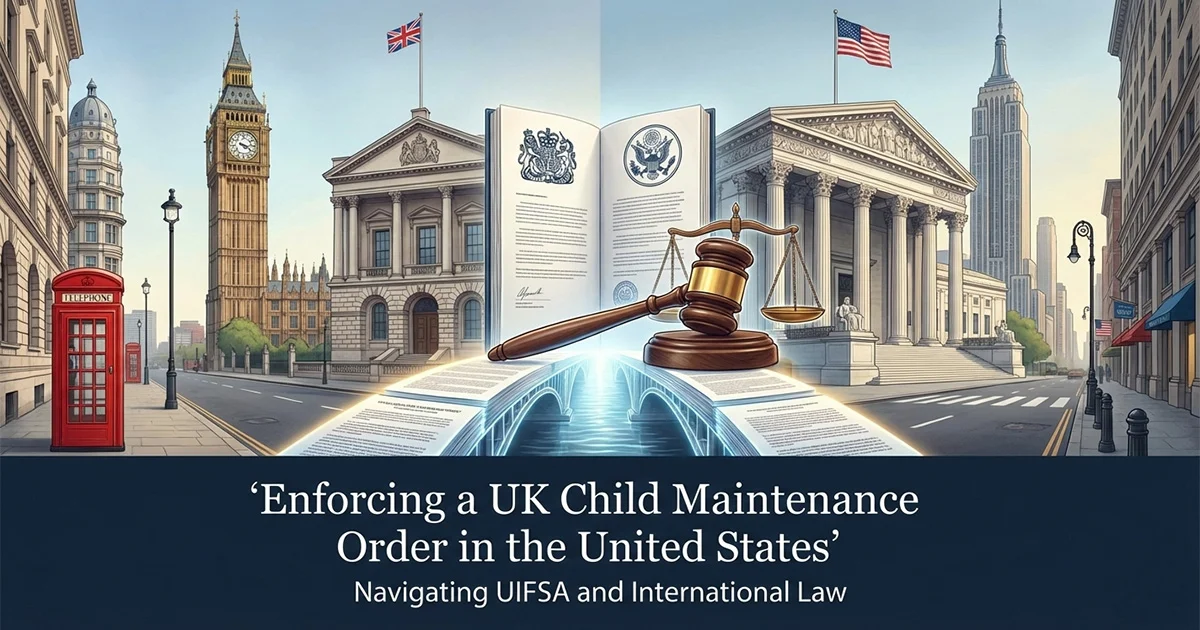
The "Race for Jurisdiction": Should You File for Divorce in London or the USA?
London vs. USA divorce: Understand the "sharing principle" vs. "equitable distribution." Learn how jurisdiction impacts high-net-worth asset division and spousal support for expats.

Introduction: The Most Critical Decision You Will Make For international couples with lives stretched across the Atlantic—perhaps a townhouse in Kensington and a penthouse in Manhattan—the end of a marriage brings a legal challenge far more complex than the divorce itself: the question of where to divorce.
In the world of high-net-worth family law, this is known as a "jurisdictional dispute" or, more colloquially, "forum shopping." While the term implies a casual choice, the financial implications are staggering. The disparity between a divorce settlement ordered by a judge in London versus one in New York or California can amount to millions of dollars in asset division and decades of difference in spousal support payments.
If you are a wealthy expatriate or an international spouse considering separation, you are likely entering a "race for jurisdiction." Understanding the distinct philosophies of US and UK courts is not just academic—it is the first and most vital step in protecting your financial future.
The Philosophical Divide: Sharing vs. Equitable Distribution To understand why jurisdiction matters, one must recognize that US and UK courts view marriage through fundamentally different financial lenses.
1. The London Approach: The "Sharing Principle" England has long been dubbed the "divorce capital of the world" for the financially dependent spouse (historically the wife). This reputation stems from the judicial "Sharing Principle" established in landmark cases like White v White.
-
The 50/50 Starting Point: English courts view marriage as a partnership of equals. Therefore, the starting point for dividing the "matrimonial pot" is an equal 50/50 split, regardless of who earned the money.
-
The "Needs" Safety Net: Even more critical for high-net-worth individuals is how English courts treat "non-matrimonial" assets (such as inheritances or pre-marital wealth). While US courts might strictly ring-fence these as separate, English courts have the discretion to invade these assets if the 50/50 share of marital assets does not meet the "reasonable needs" of the weaker spouse. In the context of a wealthy lifestyle, "needs" can include purchasing a mortgage-free home in Prime Central London, meaning the "pot" available for division often expands significantly.
-
Lifetime Maintenance: Unlike many US states that favor "clean breaks," English courts retain the power to award "joint lives" maintenance—spousal support that continues until the recipient dies or remarries. While this is becoming less common, the mere possibility provides massive leverage to dependent spouses in settlement negotiations.
2. The US Approach: Equitable Distribution Most US states, including New York, follow the principle of "Equitable Distribution." It is crucial to understand that "equitable" means fair, not necessarily equal.
-
Strict Differentiation of Assets: US courts are generally more rigid about separating "marital property" (assets acquired during the marriage) from "separate property" (assets owned prior to marriage, gifts, or inheritances). If a hedge fund manager owned their firm before the marriage, a US court is far more likely to protect that principal asset from division than a UK court.
-
Durational Alimony: The US trend has moved sharply toward formulaic, time-limited alimony aimed at rehabilitation. For example, a spouse might receive support for 30–50% of the length of the marriage, with the expectation that they will eventually return to the workforce. The concept of a "meal ticket for life" is largely extinct in US family law jurisdiction.
The Strategic "Race": Why Filing First Matters You might assume that if you live in New York, you must divorce in New York. However, jurisdiction is often established by "domicile" (where you consider your permanent home) or "habitual residence." A British banker living in New York on a visa may still retain their UK domicile, giving them the option to file in London.
This creates the "race."
-
Seizing the Forum: Historically, the "first to file" rule (lis pendens) was absolute in European disputes. While Brexit has nuanced this for UK-EU cases, filing first in US-UK disputes remains a dominant strategic move. The party who files first sets the venue, forcing the other spouse to play defense.
-
Forum Non Conveniens: If your spouse files in London, you must petition the English court to stay (pause) those proceedings on the grounds that New York is the more appropriate forum (forum non conveniens). This is an expensive, uphill battle. English judges have wide discretion and, if they believe the dependent spouse will face financial hardship in the US, they may insist on keeping the case in London to ensure "substantial justice" is done.
The Prenuptial Wildcard The existence of a prenuptial agreement adds another layer of volatility to forum shopping.
-
In the US: A properly executed prenup is generally treated as a binding contract. If it says no alimony, the court usually enforces no alimony.
-
In the UK: Prenups are not automatically binding. Following the Radmacher ruling, they are given "decisive weight," but a judge can still overrule them if they are deemed unfair or if they fail to meet the "needs" of the spouse or children. A wealthy spouse will almost always race to file in the US to enforce a prenup, while the dependent spouse may race to file in the UK, hoping a judge will set it aside.
Conclusion: Hesitation is Expensive In international divorce, silence is not golden—it is a liability. If your marriage is breaking down and you have connections to both the US and the UK, you cannot afford to "wait and see." While you hesitate, your spouse may be consulting with a solicitor in London to secure a jurisdiction that could cost you a significant portion of your net worth.
Take Control of Your Jurisdiction Do not leave your financial future to chance or the whim of a filing date. You need a legal team that understands the chessboard on both sides of the Atlantic.
Contact BestAttorneyUS.com today to schedule a confidential strategy session. We collaborate with elite family law solicitors in the UK and top-tier attorneys in the US to ensure you are positioned to win the race for jurisdiction before it even begins.
Related Articles



Featured Lawyers



Recommended Articles