The American Commercial Transportation Litigation Landscape: A Comprehensive Analysis of Liability, Regulation, and Legal Recourse (2025-2026)
Read our 2026 analysis on commercial truck accidents. Learn about federal regulations, liability, and how a specialized truck injury lawyer in the USA can secure the verdict you deserve.
Executive Summary and Market Overview
The United States commercial trucking industry serves as the arterial network of the national economy, a colossal logistical machine responsible for moving over 70% of the nation's domestic freight tonnage. However, the operational scale of this industry—comprising millions of tractor-trailers, tanker trucks, and heavy delivery vehicles—creates an inevitable and often catastrophic interface with passenger traffic. The result is a distinct, high-stakes domain of personal injury law that bears little resemblance to standard automobile accident litigation.
As we move through 2025 and into 2026, the landscape of truck injury lawyer in USA services is evolving rapidly. It is driven by shifting federal regulations, the integration of autonomous technologies, and a concerning rise in specific risk factors such as alcohol-impaired operation among commercial drivers. This report provides an exhaustive, expert-level analysis of the trucking litigation sector. It is designed for legal professionals, industry stakeholders, and those seeking to understand the granular complexities of truck crash lawyers' work.
The distinction between a generalist and a specialized truck crash attorney has never been more pronounced. The modern truck injury attorney must operate at the intersection of forensic science, federal regulatory compliance, and high-value corporate litigation. With verdicts now routinely exceeding $10 million—and occasionally surpassing $100 million—the field of top truck accident lawyers has become a highly specialized tier of the legal profession. This document will explore the mechanisms of these accidents, the rigid federal frameworks governing them, the forensic necessity of spoliation letters, and the critical criteria for selecting a truck accident injury attorney capable of securing justice in the face of billion-dollar defense strategies.
This analysis draws upon the most recent data from the National Highway Traffic Safety Administration (NHTSA), current Federal Motor Carrier Safety Administration (FMCSA) regulations, and case law developments through early 2026. It integrates detailed statistical reviews, an examination of the "nuclear verdict" phenomenon, and a step-by-step breakdown of the investigative processes that define successful litigation.
Section I: The Etiology of Commercial Vehicle Collisions
1.1 The Physics of Catastrophe
To understand the legal battles that ensue after a crash, one must first grasp the physical reality of the event. A fully loaded commercial tractor-trailer can legally weigh up to 80,000 pounds in the United States. In contrast, the average passenger vehicle weighs approximately 4,000 pounds. This 20:1 mass disparity dictates that in any collision, the forces exerted on the passenger vehicle and its occupants are devastatingly high.
The mechanics of these crashes are governed by kinetic energy, which increases with the square of the speed. Therefore, even a marginal increase in a truck's speed can exponentially increase the destructive force of an impact. Recent data indicates that speeding remains a primary contributing factor in fatal crashes. The stopping distance for a heavy truck is roughly 40% longer than that of a passenger car. At highway speeds, this difference can amount to the length of a football field. When a truck crash attorney investigates a rear-end collision, a primary focus is often the "Delta-V" (change in velocity) experienced by the victim's vehicle, a metric that biomechanical engineers use to correlate physical forces with specific injuries like traumatic brain injury (TBI) or spinal herniation.
1.2 Emerging Statistical Trends (2024-2025)
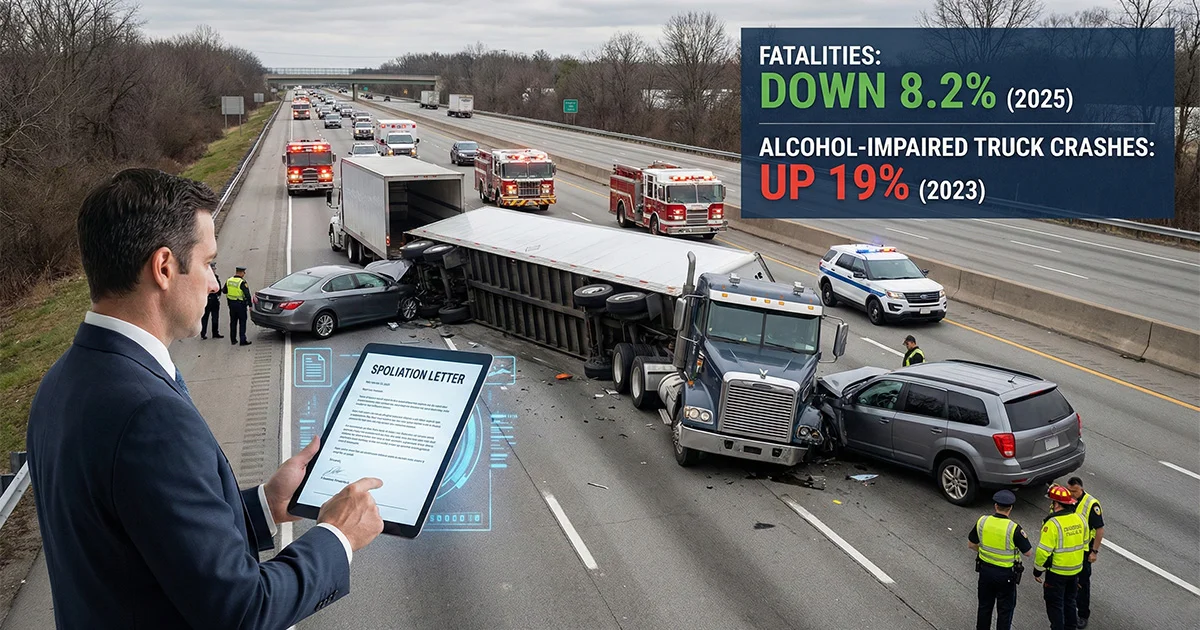
The safety profile of U.S. roadways has shown a complex dichotomy in recent years. According to NHTSA early estimates, overall traffic fatalities saw a decline in 2023 and 2024. Total fatalities dropped by 4.3% in 2023 to 40,901, and projections for 2024 indicated a further decrease to approximately 39,345 deaths. This positive trend appeared to accelerate in the first half of 2025, which saw an 8.2% reduction in fatalities compared to the previous year.
However, these aggregate numbers mask a disturbing trend within the commercial trucking sector. While general drunk driving deaths decreased, fatal crashes involving alcohol-impaired large truck drivers surged by 19% in the 2022-2023 dataset. This specific statistic serves as a clarion call for truck injury lawyer in USA practitioners to aggressively investigate driver impairment, moving beyond standard logbook checks to demand toxicology reports and credit card receipts that might evidence alcohol purchase.
Furthermore, the location of these accidents challenges common misconceptions. Analysis of 2024 data reveals that 73% of large truck crashes occurred on non-interstate roads, and 61% happened during daylight hours. This suggests that the risks are not confined to late-night highway driving but are prevalent on local roads, intersections, and rural routes where infrastructure may not separate heavy freight from local traffic effectively.
1.3 Classification of Common Crash Vectors
Legal liability often hinges on the specific type of crash, as each implies a different set of failures:
-
Underride Collisions: Perhaps the most lethal type of truck accident, this occurs when a smaller vehicle slides underneath the trailer of a truck. The structural pillars of the car are often sheared off, leading to severe head trauma or decapitation. Litigation in these cases often focuses on the adequacy of the truck's underride guards (Mansfield bars) and whether they met or exceeded federal safety standards.
-
Jackknife Accidents: This occurs when the trailer swings out to the side, forming an acute angle with the tractor. It is almost always the result of a sudden loss of traction or improper braking, often implicating the driver’s failure to adjust to weather conditions or a mechanical failure in the braking system.
-
Rollovers: High centers of gravity make trucks susceptible to rolling over on curves or in high winds. A rollover case often involves an analysis of the cargo loading manifests to determine if the load was improperly balanced or unsecured, shifting the center of gravity dangerously.
-
Tire Blowouts: A sudden tire failure can send an 80,000-pound vehicle careening out of control. Legal investigation here turns to maintenance records—specifically looking for evidence of retread usage on steer axles (which is prohibited) or failure to replace tires with insufficient tread depth.
Section II: The Federal Regulatory Framework (FMCSA)
The defining characteristic of trucking litigation, distinguishing it from general auto accident law, is the overlay of federal regulation. The Federal Motor Carrier Safety Administration (FMCSA) sets the baseline for the "standard of care" in the industry. A violation of these regulations is often argued by top truck accident lawyers as negligence per se, essentially proving the defendant's liability by virtue of the violation itself.
2.1 Hours of Service (HOS) Compliance
Driver fatigue is a pervasive, systemic issue. To combat this, the FMCSA enforces rigid Hours of Service (HOS) rules. Understanding these rules is the litmus test for any competent truck injury attorney.
Table 1: FMCSA Hours of Service (Property-Carrying Drivers)
| Rule | Constraint | Legal Implication of Violation |
| 11-Hour Limit | May drive a maximum of 11 hours after 10 consecutive hours off duty. | Driving beyond this limit is direct evidence of fatigue and statutory violation. |
| 14-Hour Window | May not drive beyond the 14th consecutive hour after coming on duty. | The clock does not stop for breaks (except sleeper berth split). Driving after the 14th hour is illegal, regardless of actual drive time. |
| 30-Minute Break | Must take a 30-minute break after 8 cumulative hours of driving. | Failure to break suggests continuous, fatiguing operation. |
| 60/70-Hour Limit | May not drive after 60/70 hours on duty in 7/8 consecutive days. | Prevents cumulative weekly fatigue. Drivers "running hot" over these limits are severe liabilities. |
| 34-Hour Restart | A 34-hour off-duty period resets the weekly clock. | Investigators check if this restart was genuine or if the driver performed off-the-books work during this time. |
Source: Consolidated FMCSA Regulation Analysis.
The complexity of these rules, particularly the "split sleeper berth" provision (allowing the 10-hour break to be split into 8/2 or 7/3 hour segments), provides ample room for defense attorneys to argue compliance. Plaintiff attorneys must be adept at auditing these logs against GPS data to find the "ghost hours"—time spent driving that was not recorded or was falsely labeled as "Off Duty" or "Sleeper Berth."
2.2 The Electronic Logging Device (ELD) Mandate
Since the implementation of the ELD mandate in 2017, the era of "comic book" paper logs has largely ended. ELDs synchronize with the truck's engine to automatically record driving time. However, this has not eliminated fraud; it has merely digitized it. Drivers may unplug devices, use "Personal Conveyance" modes improperly to advance loads while off-duty, or edit logs retrospectively. A sophisticated truck crash attorney does not just accept the PDF logbook; they demand the raw metadata and the "unassigned driving events" report from the ELD provider. Unassigned driving time is often the smoking gun of HOS violations.
2.3 Exemptions and Regulatory Loopholes
The regulations are not absolute. There are exemptions that defense teams utilize to justify deviations from the standard rules. The "Short-Haul Exemption" allows drivers operating within a 150 air-mile radius to avoid keeping detailed logs and taking the 30-minute break.9 The "Adverse Driving Conditions" exception allows a driver to extend their driving window by up to two hours if they encounter unforeseen weather or traffic. In litigation, the battle often rages over whether the snowstorm or traffic jam was truly "unforeseen" or if it was a known condition the driver should have planned for.
Section III: Investigative Strategy and Spoliation
In the aftermath of a severe truck crash, the timeline for gathering evidence is unforgiving. Trucking companies and their insurers deploy "rapid response teams" to the scene within hours—sometimes minutes—to photograph evidence, interview witnesses, and manage the narrative. The victim, often hospitalized, is at a severe disadvantage unless they engage a truck injury lawyer in USA immediately.
3.1 The Doctrine of Spoliation
Spoliation refers to the destruction, alteration, or failure to preserve evidence that is relevant to pending or reasonably foreseeable litigation. In the trucking context, this is critical because much of the evidence is digital or transient. If a trucking company destroys evidence after being put on notice, the court may impose severe sanctions, including an "adverse inference" instruction, which effectively tells the jury to assume the destroyed evidence would have proven the trucking company's guilt.13
3.2 The Spoliation Letter: The Plaintiff’s First Strike
The primary tool to prevent the destruction of evidence is the spoliation letter (or preservation letter). This is a formal legal demand sent to the motor carrier, the driver, the insurance company, and any third-party logistics providers.
A robust spoliation letter is exhaustive. It does not merely ask for "records." It specifically demands the preservation of:
-
Electronic Control Module (ECM) Data: The truck's "black box," which records speed, hard braking, engine RPM, and throttle position at the moment of impact.
-
Telematics Data: Systems like Qualcomm, Peoplenet, or Omnitracs that facilitate communication between the driver and dispatch. These records can reveal if a driver was texting dispatch while driving or if they were being pressured to meet an unrealistic deadline.
-
Driver Qualification Files (DQF): The federally mandated file containing the driver’s employment application, medical certification, road test results, and annual inquiry into their driving record. This is key to proving "negligent hiring".
-
Dash Cam and Surveillance Footage: Both driver-facing and road-facing cameras are increasingly common. This footage is often overwritten within days if not specifically preserved.
-
Maintenance and Repair Records: To identify pre-existing mechanical defects that the company ignored.
As noted in the research, "Without a spoliation letter, these smoking guns vanish forever". The letter serves as the legal trigger that converts a company's routine document destruction policy into an act of spoliation.
3.3 Advanced Accident Reconstruction
Top truck accident lawyers do not rely solely on police reports. They employ independent accident reconstructionists to map the scene using LiDAR (Light Detection and Ranging) technology. This creates a 3D digital twin of the accident site, allowing for precise measurements of skid marks, yaw marks, and gouge marks. When combined with the ECM data, experts can determine the exact speed of the truck at the moment of impact and whether the driver reacted appropriately (e.g., braking vs. steering).
Section IV: Liability: Piercing the Corporate Veil
Determining who is at fault in a truck accident is rarely as simple as blaming the driver. The driver is often the "statutory employee" of a larger entity, but the web of liability can extend to multiple corporations.
4.1 Vicarious Liability and Respondeat Superior
The legal doctrine of respondeat superior holds an employer liable for the negligent acts of its employees committed within the scope of their employment. This is the primary mechanism for accessing the trucking company's insurance policy, which typically carries significantly higher limits than personal auto policies.
4.2 The Independent Contractor Defense
A standard defense tactic is to claim the driver is an independent contractor, not an employee, thereby insulating the trucking company from vicarious liability. Truck crash lawyers fight this by analyzing the "right of control." If the company dictates the driver's schedule, provides the truck, requires the use of company logos, or controls the method of performance, the law often treats the driver as a "statutory employee" regardless of the label in their contract.
4.3 Systemic Negligence and Direct Liability
Beyond vicarious liability, truck injury attorney practitioners seek to establish the direct negligence of the corporation. This includes:
-
Negligent Hiring: Did the company hire a driver with a history of DUIs or license suspensions?.
-
Negligent Training: Did the company fail to train the driver on the specific equipment or route?
-
Negligent Supervision: Did the company ignore alerts from their own telematics systems showing the driver was speeding or violating HOS rules repeatedly?
-
Negligent Maintenance: Did the company defer necessary brake repairs to keep the truck on the road?.
4.4 Third-Party Liability
The liability net often widens to include:
-
Shippers/Loaders: If the accident was caused by a load shift or an overloaded trailer, the entity that loaded the cargo (often different from the driver) faces liability.
-
Brokers: Freight brokers who negligently select a carrier with a poor safety rating (a "chameleon carrier") can be held liable for the carrier's negligence.
-
Manufacturers: Defective parts—such as tires that de-tread or brakes that fail due to design flaws—trigger product liability claims.
Section V: The Economics of Justice: Damages and Compensation
The consequences of a collision with an 80,000-pound vehicle are often life-altering. The legal system attempts to make the victim whole through the award of damages. In the realm of truck accident injury attorney work, calculating these damages is a complex actuarial exercise.
5.1 Economic Damages
These are the objective, quantifiable financial losses.
-
Medical Expenses: This encompasses not just the emergency room bills, but the entire trajectory of care: surgeries, physical therapy, medication, and durable medical equipment.
-
Life Care Plans: For catastrophic injuries like Traumatic Brain Injury (TBI) or spinal cord paralysis, a "Life Care Planner" is retained to project the cost of care for the remainder of the victim's life. This can include home health aides, wheelchair replacements, and home modifications, often totaling millions of dollars.
-
Lost Wages and Earning Capacity: If a victim can no longer work, or must take a lower-paying job, a forensic economist calculates the "present value" of that lost income stream over their expected working life.
5.2 Non-Economic Damages
These subjective damages compensate for the human cost of the injury.
-
Pain and Suffering: Compensation for the physical agony and emotional trauma endured.
-
Loss of Enjoyment of Life: Damages for the inability to engage in hobbies, sports, or family activities.
-
Loss of Consortium: Compensation for the spouse or family of the victim for the loss of companionship, affection, and support.
5.3 Punitive Damages
In cases where the defendant's conduct was not just negligent but "grossly negligent," malicious, or exhibited a "conscious disregard" for safety, punitive damages may be awarded. These are not meant to compensate the victim but to punish the wrongdoer and deter the industry. Examples include accidents caused by a drunk driver or a company that knowingly allowed a truck with failed brakes to operate. While rare, punitive damages are the driver of "nuclear verdicts" and are a powerful lever in settlement negotiations.
5.4 Case Valuations and Verdicts
The market value of these cases is established by jury verdicts. Recent data highlights the scale of potential recovery:
-
$100 Million Settlement: A benchmark for catastrophic systemic negligence.
-
$82.1 Million Verdict: For a truck vs. motorcycle crash, highlighting the vulnerability of motorcyclists.
-
$18.5 Million Verdict: Recovered for a head-on collision involving a semi-truck.
-
$11.99 Million Verdict: Significantly, this verdict was won after the insurance company offered only $2.3 million, demonstrating the necessity of a trial-ready truck crash attorney.
Section VI: Selecting the Right Counsel: The "Best Attorney" Criteria
Given the specialized nature of this litigation, the choice of legal representation is the single most critical decision a victim will make. The market is flooded with generalist personal injury lawyers, but true top truck accident lawyers possess specific credentials and resources.
6.1 Board Certification and Industry Leadership
One of the most reliable indicators of expertise is board certification. The National Board of Trial Advocacy (NBTA) offers a specific board certification in Truck Accident Law. This certification requires rigorous testing, peer review, and a documented history of truck accident trials. Firms that boast board-certified attorneys, such as Munley Law or those affiliated with the Academy of Trucking Accident Attorneys (ATAA), have objectively demonstrated their competence.
6.2 Financial Resources
Trucking cases are expensive to litigate. The cost of accident reconstruction experts, biomechanical engineers, trucking standard-of-care experts, and life care planners can easily exceed $100,000 before a trial even begins. A "top-rated" firm must have the financial stability to advance these costs on a contingency basis, meaning the client pays nothing upfront and the firm assumes the financial risk of the litigation.
6.3 The Client Interview: Questions that Matter
When interviewing potential counsel, victims are advised to ask probing questions to separate marketing from substance:
-
"How many truck accident cases have you taken to a jury verdict?" (Many lawyers settle everything; trial lawyers get better settlements).
-
"Are you a member of the AAJ Trucking Litigation Group?"
-
"Will you be handling my case personally, or will it be passed to a junior associate?".
-
"Can you show me examples of spoliation letters you have drafted?"
6.4 Strategic Location and Licensing
While many firms advertise as truck injury lawyer in USA, trucking law is state-specific regarding procedural rules and comparative negligence standards. However, the best firms often operate nationally, either by being licensed in multiple states or by "pro hac vice" admission (partnering with local counsel). This allows them to bring their specialized federal trucking knowledge to any jurisdiction where a major crash occurs.
Section VII: The Attorney-Client Partnership and Process
7.1 Immediate Post-Accident Protocol
For the victim, the steps taken immediately after a crash are vital.
-
Medical Priority: Health is paramount. Adrenaline can mask injuries. A clear medical record starting from the day of the crash is essential for proving causation.
-
Evidence Collection: If possible, photos of the scene, the truck’s door signage (identifying the carrier and DOT number), and witness contact info should be gathered.
-
Silence with Insurers: The trucking company's insurer will contact the victim quickly, often feigning concern to extract a recorded statement. These statements are traps. The universal advice from truck crash lawyers is to decline all comment until represented.
7.2 The Litigation Lifecycle
-
Investigation Phase: Sending spoliation letters, downloading black box data, interviewing witnesses, and inspecting the vehicles.
-
Filing the Complaint: Initiating the lawsuit, which stops the "statute of limitations" clock.
-
Discovery: The exchange of information. This is where the defense must hand over the driver’s disciplinary file, the company’s safety manuals, and the raw ELD data.
-
Mediation: A neutral third party tries to help the sides reach a settlement. Most cases resolve here if the plaintiff's attorney has built a "trial-ready" case.
-
Trial: If the insurer undervalues the claim, the case goes to court. This is where the narrative of the crash is presented to a jury.
Section VIII: Future Outlook and Emerging Risks
As we look toward the remainder of 2026, several trends are reshaping the truck accident injury attorney field.
8.1 Automation and Liability
The integration of Level 2 and Level 3 autonomous driving features in commercial trucks is complicating liability. If a truck's collision mitigation system fails to brake, is the driver liable for not intervening, or is the manufacturer liable for a product defect? This hybrid liability model will likely increase the complexity of future litigation.
8.2 The "Last Mile" Danger
The explosion of e-commerce has led to a proliferation of delivery vans and smaller box trucks in residential neighborhoods. These "last mile" drivers are often under extreme time pressure and may lack the CDL training of long-haul truckers. This segment represents a growing area of accident frequency.
8.3 The Persistence of "Chameleon Carriers"
Regulators continue to struggle with "chameleon carriers"—trucking companies that are shut down for safety violations, only to reopen under a new name and DOT number. Sophisticated legal investigation is required to trace the assets and ownership of these entities to pierce the corporate veil and hold the operators accountable.
Conclusion
The pursuit of justice following a commercial truck accident is one of the most intellectually and financially demanding areas of American law. It is a confrontation between the rights of the individual and the logistical imperatives of a multi-billion dollar industry. For the victim, the path to recovery relies on the intervention of a skilled truck injury attorney—an advocate who can decipher the black box data, navigate the FMCSA regulations, and articulate the profound human loss to a jury.
As the statistics from 2024 and 2025 demonstrate, the risks are evolving but the severity remains constant. Whether dealing with a fatigued driver, a neglected brake system, or a corporate culture that prioritizes speed over safety, the legal system remains the final bulwark for those injured on the nation's highways. For those seeking a truck injury lawyer in USA, the directive is clear: seek specialization, demand certification, and ensure your counsel has the resources to fight the long battle for full compensation.
Related Articles
Lawyers Mentioned

Victoria "Tori" Tuhovak
View Profile



Recommended Articles